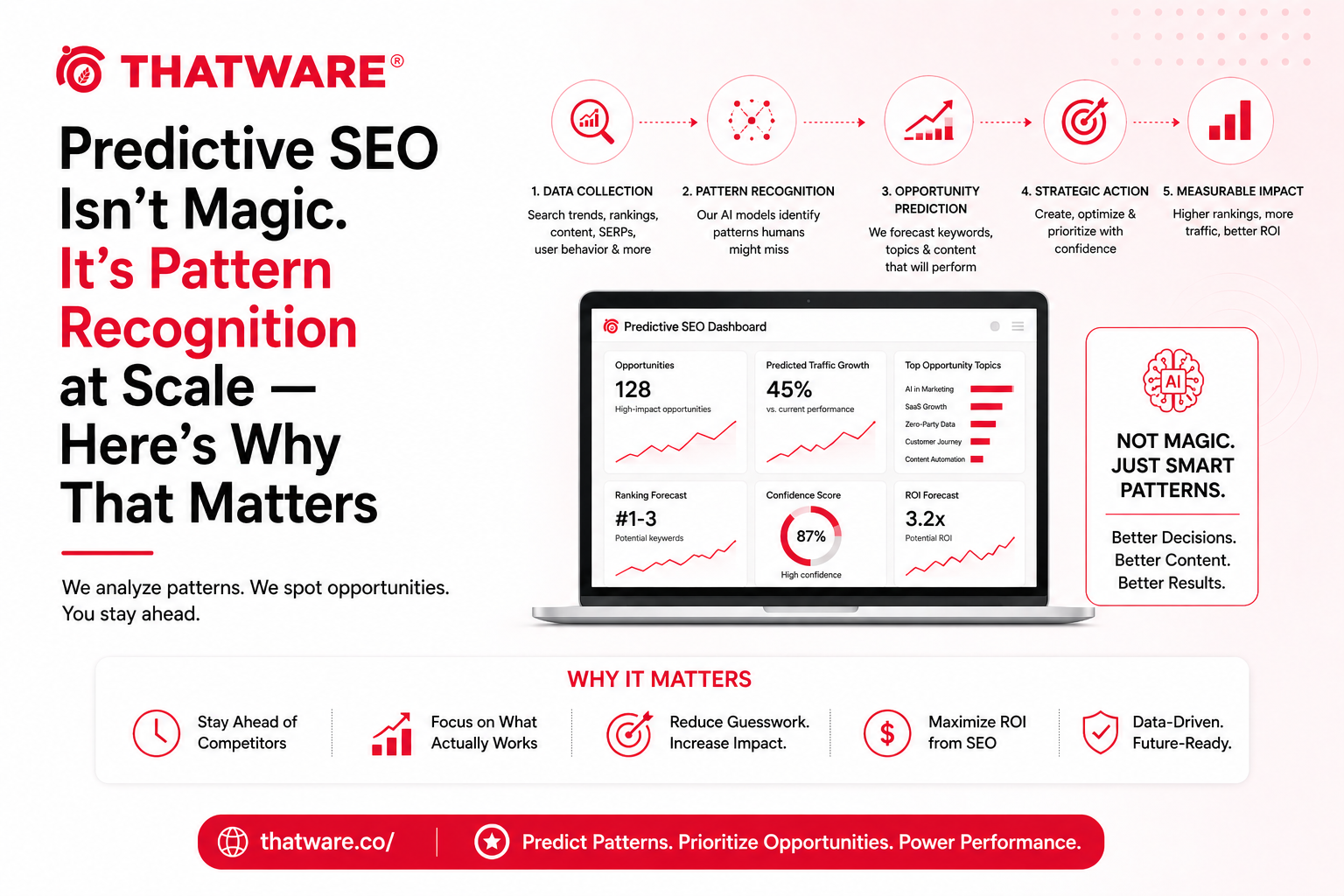
The word “predictive” in SEO context tends to prompt either over-credulous excitement or dismissive skepticism. The excited version imagines some oracle that knows exactly what Google will do next. The skeptical version points out, correctly, that nobody has a crystal ball and any claim to predict algorithm changes is nonsense.
Both reactions miss what’s actually useful about predictive SEO. It’s not prophecy. It’s pattern recognition is applied systematically to search behavior, competitive dynamics, and the direction of search development. And pattern recognition at scale – done rigorously, not heuristically – produces consistently better strategic decisions than reactive optimization or intuition-based planning.
Here’s what that means in practice, and why the distinction matters.
The Three Patterns Worth Recognizing
Predictive SEO in practice focuses on three distinct pattern types, each operating on different timescales and requiring different analytical approaches.
Search trend patterns: how search behavior in a category is evolving over time. Which queries are growing? Which are declining? Where is new demand emerging before it becomes a high-volume, high-competition keyword category? This is the most accessible form of predictive analysis – tools exist, the data is observable, and the patterns are often legible months before they become obvious in keyword volume data.
Competitive movement patterns: how do competitors in a given category typically respond to ranking losses, algorithm changes, or market shifts? What’s the lag between a competitor losing rankings and their response? What types of investments do they typically make – content-heavy, link-heavy, technical-heavy – and how effective have those responses historically been? Understanding the competitive playbook lets you anticipate responses and position ahead of them.
Algorithmic development patterns: the direction of Google’s search quality development has been remarkably consistent over time. Quality signals that Google has emphasized in public statements, quality rater guidelines, and patent filings consistently foreshadow where ranking factors are heading. Identifying these signals early and building toward them produces compounding advantage over brands that wait for the changes to manifest in ranking behavior.
Why Reactive Strategy Is Becoming More Expensive
The economic case for predictive SEO gets stronger as the search environment becomes more complex and faster-moving.
In a stable search environment, reactive optimization works fine. Google changes something, you respond, you recover, the cost of the lag is manageable. But the search environment has become less stable. Major updates are more frequent. The AI integration is introducing changes on a different timeline and through different mechanisms than traditional algorithm updates. Competitive dynamics in most categories are intensifying.
In this environment, each reactive cycle is more expensive: longer recovery periods, more competitive pressure during the lag, more expensive catch-up investment once the problem is identified. The cumulative cost of consistently being behind the change is higher than it used to be.
Predictive seo services are partly a cost-reduction strategy – reducing the frequency and severity of reactive catch-up cycles – as well as an opportunity capture strategy. Both returns are real.
How Pattern Recognition Actually Works in SEO
Pattern recognition in SEO isn’t mystical. It’s applied analytical discipline to observable data, used to make probabilistic statements about what’s likely to happen next.
Search trend pattern recognition uses keyword volume trajectory data, Google Trends, social signal monitoring, and industry intelligence to identify categories of queries that are increasing in demand before they become highly competitive. A brand that publishes authoritative content in a query category 6-12 months before demand peaks enters the peak demand period with established rankings – often without significant paid competition for those terms – while brands that respond to the trend after it’s visible enter a crowded, expensive market.
Competitive pattern recognition uses historical competitor behavior data – ranking changes, content publication cadence, backlink acquisition patterns, site changes – to model how specific competitors are likely to respond in different market situations. This is particularly useful for anticipating where competitors will invest after an algorithm change, which informs where to invest ahead of the expected response.
Algorithmic pattern recognition requires reading a wider range of signals than most SEO practitioners monitor: Google’s developer documentation, quality rater guideline updates, public statements from Google representatives, patent filings (which often foreshadow algorithmic development by 12-24 months), and the research literature that Google’s teams publish. These signals consistently telegraph the direction of search quality development in ways that reward attentive readers.
The Content Investment That Pays Off Twice
One of the most consistent practical benefits of advanced seo intelligence services applied to content strategy is what you might call the double-pay content investment: content that’s optimized for current demand AND positioned for anticipated demand growth.
A piece of content targeting an emerging query category that’s currently modest in volume but growing consistently gets two payoffs: it ranks while competition is relatively low, building authority during the period when ranking is most efficient, and it captures increased traffic as demand grows without requiring additional investment. The timing advantage compounds.
This is different from producing content purely to target high-volume competitive terms, where the investment required to rank is high and the reward is shared with entrenched competitors. Predictive content positioning creates a window where the investment-to-return ratio is most favorable – by getting there early enough that the competition hasn’t fully shown up yet.
Realistic Expectations and Honest Limitations
Predictive SEO is worth being honest about what it doesn’t do. Pattern recognition produces probabilistic guidance, not certainty. Some trends don’t materialize as expected. Some algorithmic developments surprise even the most attentive observers. Competitive responses don’t always follow historical patterns.
The value of predictive SEO isn’t that it’s always right – it’s that being systematically early to emerging opportunities and proactively positioned for directional changes produces better outcomes on average than being systematically reactive, even accounting for the times when the prediction misses.
Think of it like weather forecasting. A 70% probability of rain isn’t a guarantee, but it’s useful information that produces better decisions than ignoring the forecast. Predictive SEO produces useful probability estimates – “this query category is likely to grow significantly in the next 12 months,” “Google is consistently signaling that this type of content will be more valuable in the next major update” – that improve decision quality even when specific predictions miss. That’s the honest, valuable version of what pattern recognition at scale actually delivers.